
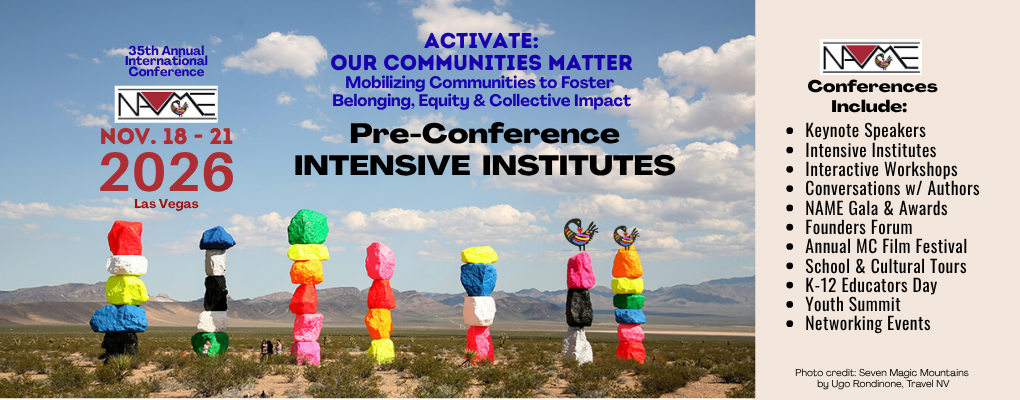
This year NAME's Annual Conference offers a selection of Intensive Institutes during the Pre-Conference Day, Wednesday November 18th. These half- and full-day offerings provide longer sessions that allow you to dive deeper into critical topics with some of NAME's outstanding leaders.
There are additional fees to participate and pre-registration is required. Space is limited, so we encourage early registration.
If you have already registered for the 2026 conference, you can still add Institutes (or other events) by returning to the conference registration form and using the ADD-ON button.
Institute Fee With NAME Conference Registration:
- Fee for a Whole-Day Intensive Institute: $49 NAME member / $69 Non-member
- Fee for each Half-Day Intensive Institute: $29 NAME member / $49 Non-member
- Half-day Institute: $29 NAME member / $49 non-member
- Full-day Institute: $49 NAME member / $69 non-member
FULL DAY Institutes: Weds. Nov. 18 / 9:00 a.m. - 4:00 p.m.
Writing for Publication.
Presenters: Kevin Roxas, editor of NAME's Journal, Multicultural Perspectives and Dean of Woodring College of Education, Western Washington University; and María Gabriel, DEI Coordinator for the Thompson School District (CO). Both presenters are winners of NAME MC Educator of the Year Award.
This institute is designed to assist anyone interested in publishing about multicultural education in professional journals or other related publications. The session is particularly beneficial to graduate students and junior faculty. During this interactive workshop, participants will learn about the process of writing for publishing from the NAME editor's perspective. Topics to be covered include getting started (selecting appropriate journals, turning dissertations into articles, etc.), the submission and review process, and the relationship of publishing to tenure. Participants should be prepared to share and discuss their article ideas. Participants will receive materials to support their work towards becoming published authors.
Developing a Multicultural Education Institute.
Presenter: Bill Howe, Past President of NAME and recipient of NAME Educator of the Year and NAME MC Book Award.
This highly regarded institute is designed for students, teachers, school leaders, and higher-education faculty seeking practical, research-informed strategies for advancing multicultural education across learning environments.
Participants will explore:
How to design and implement multicultural lesson plans
Best practices in culturally responsive and inclusive teaching
Core characteristics of multicultural classrooms and schools
Strategies for effectively teaching students from diverse racial, cultural, linguistic,and social backgrounds
Approaches for creating learning environments where students feel physically safe, emotionally supported, and academically valued
The institute also addresses the knowledge, skills, and dispositions students need to thrive in an increasingly interconnected and global workforce, emphasizing equity, empathy, critical thinking, and cross-cultural competence.
Training on Title IX.
Presenters: Jan Perry Evenstad, PhD, Professor Emeritus, Metropolitan State University of Denver; Advisory Board Member of ATIXA; Marta Larson, MA, Educational Equity Consultant, former Program Manager, Equity Assistance Center at University of Michigan
Title IX of the Education Amendments of 1972 prohibits discrimination based on sex in education programs that receive federal funding. "On April 19, 2024, the U.S. Department of Education released its Final Rule under Title IX. On January 9, 2025, a federal district court issued a decision vacating the 2024 Final Rule. The Department's 2020 Title IX Rule is now back in effect and is the basis for OCR enforcement of Title IX (USDOE)." This intensive institute led by experienced Title IX experts will provide attendees with the information needed to understand the current status of the law, protections provided, and obligations of educational institutions. With the new federal administration, other changes have been proposed and those will be explored to the extent that this information has been made available. Connections, parallels, and intersections between Title IX and multicultural education will be explored. Case studies will be included. This institute should be of interest to all designated Title IX Coordinators from Elementary to Higher Education, other school administrators, parents/guardians, school board members, and advocates. Attendees will receive a Certificate of Attendance for this Title IX training.
The Scratch Line Moment: Framing and Maintaining a Research Agenda, and Finding Harmony in an Anti-DEI Era.
Presenter: Fred A. Bonner, Executive Director of Minority Achievement, Creativity and High Ability Center (MACH III); Professor at Prairie View A&M University (TX)
This Full-Day Intensive Institute will be delivered in two synergistic Phases. Phase I will focus on a 15-point framework for developing and sustaining a scholarly research agenda that focuses on career and professional goals (e.g. tenure and promotion). Phase II will focus on key strategies to empower faculty to move beyond notions of work-life-balance, to a more holistic approach that foregrounds work-life-harmony. The goal is to create space for reflection and to provide 'authentic' best practices, strategies, and tips that illuminate ways that faculty can 'thrive' despite the deficits and constraints that are sometimes experienced within the halls of Academia. Activities across the session, participants will be engaged in hands-on activities that will require them to think through the development of their mentoring networks, research agendas, and writing cartels.
HALF-DAY INSTITUTES / Morning Institutes: 9:00 am - 12:00 pm
Improv and Comedy in the Classroom: Creativity, Belonging, and Culturally Relevant Practices.
Presenter: Dan Hart, Literacy Specialist, East Upper School of Rochester City School District (NY)
This interactive workshop invites educators and students to explore how comedy and improv can make reading, writing, and communication more fun and engaging. Participants will take part in improvisation activities, collaborative storytelling, and humor-based exercises that strengthen literacy skills, boost creativity, and build literacy confidence. Additionally, the session will explore ways comedy can be a tool of criticality. In using comedy, students can engage in deep analysis of audience, context, and language in order to determine overt and subtle messages present in comedic texts.
Furthermore, Improv and comedy represent practices that foster collective joy, belonging, and relational awareness. Attendees will leave with practical strategies they can use in their own learning to make their classroom instruction and curricular pursuits dynamic and joyful.
Navigating Authoritarian Legislation for Democratic Educational Purposes.
Presenter: Dilys Schoorman, Ph.D. is a Professor in the College of Education at Florida Atlantic University; current board member of NAME; winner of NAME MC Educator of the Year Award.
The field of multicultural education was birthed as a quest for realizing the dreams of a pluralistic democracy, even in the midst of hostile and bigoted policy environments. Contemporary legislation against the fundamental work of multicultural educators places us on the front lines of this ongoing struggle in 2026. Based on her experiences with the tsunami of anti-equity and authoritarian legislation in Florida since 2021, Dilys Schoorman will share insights from lessons learned about how multicultural educators might navigate the hostile legislative climates that they face.
The workshop, geared largely towards higher education faculty and leaders, though also relevant to K-12 educators, will focus on: the why, the what, the who and the how of contemporary legislation to reveal the rationale and strategies underlying this agenda; contrasted with a discussion of the why, what, who and how of multicultural educators who wish to counter the inequity of this legislation, even while maintaining compliance with the letter of the laws. Practical short-term and long-term strategies will be offered for individual and collective efforts as a well as a set of resources ranging from scholarly
articles, instructional resources, infographics and websites will be offered to all
attendees.
This workshop will also serve as a forum for NAME to learn more about the experiences, challenges and responses of its members in this challenging legislative context so as to provide ongoing support and resources for one another.
Dilys Schoorman, is committed to scholarship as counter-hegemonic praxis, her recent scholarship focuses on critical policy analysis of curriculum censorship laws in Florida.
The Pursuit of Happiness: A Joyful Humanities Exploration Across the Globe Through Literature and Digital Text.
Presenters: Benita R. Brooks, Department of Teaching & Learning Chair, UNLV; and Chyllis Scott, Professor of Literacy Education and Assoc Director, Department of Teaching & Learning, UNLV
The Pursuit of Happiness Institute examines happiness not simply as a personal feeling, but as a broader
concept of well-being shaped by individual experiences, relationships, and cultural contexts around the world. Inspired by Yale University’s course The Science of Well-Being and expanded through coursework developed at the University of Nevada, Las Vegas, this session introduces participants to the growing field of well-being studies through an interdisciplinary lens that draws from psychology, education, sociology, and cultural studies.
Using Martin Seligman’s PERMA framework- positive emotion, engagement, relationships, meaning, and accomplishment- participants will explore how flourishing can be understood, discussed, and intentionally cultivated in everyday life. Rather than viewing happiness as a fixed trait or temporary emotion, this session reframes the conversation toward well-being as a learnable practice and a language for understanding how people thrive. Participants will begin to develop the language of well-being by learning concepts, vocabulary, and reflective practices that help them name and recognize flourishing in themselves and others.
The session integrates global literature, narratives, and international data sources to examine how well-being is influenced by social, cultural, economic, and environmental conditions across different regions of the world. Through literature and digital texts, participants will compare how various cultures define joy, fulfillment, belonging, and purpose. These global perspectives highlight that well-being is both personal and collective, shaped not only by choices, but also by communities, opportunities, and environments.
Each module focuses on one dimension of the PERMA framework and connects research-based ideas to practical applications in participants’ daily and professional lives. Through short videos, readings, discussions, and reflective activities, attendees will explore how well-being develops through ordinary moments such as gratitude, attention, relationships, perseverance, and purposeful action. By the end of the session, participants will leave with a deeper understanding of global well-being perspectives and an expanded vocabulary for cultivating flourishing in their own lives and in the communities they serve.
HALF-DAY INSTITUTES / Afternoon Institutes: Weds. Nov. 18 / 2:00 - 5:00pm
Fix Injustice, Not Kids and Other Principles for Transformative Racial Equity.
Presenter: Paul Gorski, Author and Founder of Equity Literacy Institute of EdChange; winner of NAME MC Book Award.
Description: In many schools, the trouble is not so much the scarcity of equity efforts as the tendency to embrace equity approaches that pose no real threat to inequity. In this intensive institute, we will explore, and practice applying, a set of transformative racial equity principles meant to push us from little mitigations to big transformations, from tinkering to reimagining. We will discuss what embracing a more transformative approach to racial equity looks like against the tide of anti-“DEI” sentiment and how to sustain ourselves and one another in that tide.
Dancing Towards Liberation: Teaching Through Afro-Diasporic Movement and Story.
Presenter: Stacey Allen, Author and Director of Artistic Programming, The Anderson Center for Arts; NAME Children's Publication Award winner
This immersive workshop invites educators to explore how Afro-diasporic movement traditions can serve as powerful entry points for cultural literacy, historical inquiry, and student engagement across content areas. Rooted in my work with The Fairytale Project, Aesthetic Inheritances, and Sacred Steps, a professional development model designed to support culturally responsive, arts-integrated instruction, this session blends movement, storytelling, and reflective practice to support holistic learning.
Grounded in Black cultural traditions and migration stories across the American South, participants will engage in guided movement experiences inspired by communal practices such as the ring shout, alongside structured opportunities for dialogue and meaning-making. The workshop centers embodiment as a way of knowing, offering educators tools to expand how literacy, history, and identity are taught and experienced in the classroom.
This session also introduces practical, research-informed strategies that support integration of movement, music, and storytelling into social studies, literacy, and social-emotional learning. Participants will explore how embodied approaches can foster deeper comprehension, cultural affirmation, and inclusive learning environments for diverse students.
Educators will leave with adaptable lesson frameworks, clear instructional strategies, and tangible tools to implement culturally responsive teaching practices with confidence and care.
Black Wisdom Rising: From Protesting Anti-Blackness to Rebuilding Black-Centric Learning Infrastructures.
Presenters: Collaborative Team: Martin P. Smith, Duke University; M. Billye Sankofa Waters, Michigan State University; KO Wilson, Seattle Central College; Veli Gasa, University of South Africa; and Christopher B. Knaus, University of Washington-Tacoma and NAME MC Research Award Winner.
While the current US regime wages war against social structures, multicultural education, and humanity, at the core of this devastation lies intentional and systemic anti-Blackness. This ½ Day interactive critical race theory-informed institute begins with a framing of global historic and contemporary anti-Blackness structures that limit education systems from teaching multicultural education, Black studies, and related approaches to helping young people fully consider Blackness and Black people. We clarify how misrepresentations of Black historical context foster genocidal tendencies that give rise to white supremacist regimes - outlining how the US arrived at our current moment. We then position global Black protest efforts as foundational to societal progress, highlighting numerous movements that were built upon - and that ultimately exploited - Black protest labor. We conclude with participant strategy mapping to reinvest in Black-centric learning approaches that foster Black identities, communities, solidarities, and wisdoms.
This session is open to all educators committed to deepening learning, to recognizing the depth of anti-Blackness that shapes the US and globe, and to moving towards global liberation.
DEI Hire or DEI Fire? Leading while Healing.
Presenter: María L. Gabriel, Ph.D., Diversity, Equity, Inclusion (DEI) leader in Northern Colorado for 21 years; winner of NAME MC Educator of the Year award.
María L. Gabriel feels that over the past five years, People of Color holding DEI titled positions have become one of the most controversial positions across the country given the political landscape in the USA. She will share her personal story of being a Latina educator for nearly three decades, and her focus on healing. Participants will receive a journal and sensory items as we engage in self-reflection and healing practices based in Healing-Centered Education (Acosta, 2020; Ginwright, 2025) and considerations for addressing Complex PTSD due to racial trauma (Gutiérrez, 2022). By acknowledging the significant barriers to being critical multicultural educators, and moving towards healing practices, she aims to create a safer and braver space for reflection, writing, speaking, moving, healing, and leading.